Sunday, September 18, 2016

DESTINATIONS: NYC about to host an eclectic and exciting Architecture & Design Film Festival


 NYC's Architecture & Design Film Festival 
coming soon: Sept. 28 - Oct. 2

 
 Photo from Some Kind of Joy: 
The Inside Story of Grimshaw in Twelve Buildings

A group of extraordinary design-related films
will be screened at Cinépolis Chelsea in NYC (260 West 23rd St.),
starting in about a week. This year's selections may be the strongest field 
yet offered during this highly-anticipated annual event.


The festival kicks off with 
Eero Saarinen: The Architect Who Saw the Future.

The film follows the modernist designer's son, Eric,
as he makes a "a cathartic journey through the sites of his father’s work." 
Included are National Historic Landmarks such as St. Louis’  Gateway Arch (seen above) and the General Motors Technical Center in Michigan. Saarinen also designed New York’s TWA Flight Center at JFK International Airport, Yale University's Ingalls Rink, Morse and Ezra Stiles Colleges, Virginia’s 
Dulles Airport, and modernist furniture such as 
the enduringly popular Tulip Chair.


 °     °     °     °     °     °     °     ° 
Toshie lovers (like me), take heart! At last a film -- which will premiere in the US at this festival -- has been made about visionary Scottish architect Charles Rennie Mackintosh's singular influence on design and architecture over the late 20th century and beyond. Mackintosh's work did not receive the acclaim and worldwide recognition it deserved in its time -- in an era of over-the-top Victorian decoration it was seen as too restrained, and sometimes even "spooky" -- but in recent decades it has come to the fore again. His Glasgow School of Art has regularly  been voted the greatest architectural masterpiece in the UK.
Above: Entrance to the iconic Glasgow School of Art, designed by 
CRM in 1902, completed in 1909. Drawing by Gerald Blaikie.

Facing up to Mackintosh (2014), will be screened at the NYC Design Film Festival on Thurs., Sept. 29 (7PM) and Sat. Oct. 1 (6PM, w Q & A to follow). The film depicts the conception and construction of the Glasgow School of Art's new design school, now known as the Reid Building, located across the street from the original and beloved Mackintosh Building ("The Mac"). The film explores how a space affects the people who work in it, and how an older building that no longer serves its purpose (the newer venue had been built in the 1960s) can be recreated and brought up to state-of-the-art standards.


 °     °     °     °     °     °     °     ° 
Intermission: Judy's mini-film festival ...
 I'm cutting now to some pics unrelated to the NY film festival, 
just because I love this place, and feel like showing it off.

 Below is the exterior of Mackintosh's dreamy House for an Art Lover.
          The design for the house was created in 1901 by Mackintosh and his artist wife Margaret MacDonald for a German art magazine competition, 
 and won first prize. It was actually built nearly 100 years later.


Plans for the house remained as a set of water colors in a desk drawer,
until a consortium of city and regional authorities, along with the
Glasgow Development Agency and private donors, brought it to reality.

Located in beautiful Bellahouston Park, the House for an Art Lover
has become a major draw for tourists, and also hosts conferences and weddings.

Below: The Music Room


This room was recreated using Mackintosh's watercolor drawings, by
top-notch Scottish artists and artisans. There were no measurements
or architectural drawings to use for reference. 
See A Vision Realized: Mackintosh's House for an Art Lover
for more information about this exquisite venue.

 °     °     °     °     °     °     °     °
Back to the NYC Festival ...


Some other titles that caught my eye were:

Design that Heals 
A MASS Design Group is challenged to design a cholera treatment center where the construction process, as well as the finished building, could address the underlying structural and social conditions that allow the disease to thrive in Haiti.

The Happy Film
Austrian Graphic Designer Stefan Sagmeister is doing well. He lives in New York, the city of his dreams, and is successful in his work, designing album covers for the Rolling Stones, Jay-Z and Talking Heads. But deep down he suspects there must be something more to life. He decides to turn himself into a design project.  

Talking House: Eileen Gray & Jean Badovici 
A photo montage of Villa E-1027, the iconic modernist villa built by Eileen Gray and Jean Badovici on the Cote d’Azur in 1929.(Note: I've written extensively about Eileen Gray and the E-1027 house; for more info and lots of pics, see my article "Eileen Gray: from Shadow to Light", (Modernism magazine, spring 2011)
 
Windshield: A Vanished Vision
This film "lands us in the 1930’s to reveal an intimate portrait of a patrician couple, a leading modern architect, and the story of the ill-fated house they create. John Nicholas Brown's fascination with modernism, innovation and the rapidly-evolving American building scene spurs him to commission what he hopes will be a distinguished monument in the history of architecture.”Just weeks after the Browns move in, though, tragedy strikes.

The Novgorod Spaceship 

 This place actually exists, in Novgorod, Russia! 
"Like an abandoned alien spaceship, the building of Dostoevsky's Drama Theater stands on the bank of the Volkhov River, only a kilometer away from the walls of famous Novgorod Kremlin. An architectural freak, unloved and uncared for, it was erected during the final years of Soviet rule -- a remarkable example of modernist architecture that has, for  decades, continued to mock the ancient heritage of the city, as well as the mediocre tastes of its populace... The building's slow but sure demise at the hands of greedy bureaucrats is a metaphor for Russian society today."

~ oOo ~

for more information about the festival, visit
the ADFF website, here 

Thursday, September 8, 2016

BOOK REVIEW: Fascinating: the Life of Leonard Nimoy -- a shining tribute to a visionary artist


Fascinating: The Life of Leonard Nimoy
by Richard Michelson, illustrated by Edel Rodriguez
Alfred A. Knopf Books for Young Readers, 2016, $17.99

  Third-grader Lenny Nimoy nervously peeks through the curtain of his school’s little theater, watching an audience gather. He has been recruited quite suddenly to open the night’s talent show with his rendition of “God Bless America”, after the school’s social director Mr. Chalfin had heard his resonant voice belting out the Shema prayer at synagogue.

As he is nudged on to the stage, he is delighted to see that front-row seats have been reserved for his proud parents. Mr. Chalfin presciently bends down and whispers to him “Reach for the stars!”, and a career is born.

Feeling befuddled was not a new sensation for Lenny. When his Yiddish-speaking Russian Jewish immigrant parents had arrived in Boston, their passports had been stamped “alien”, a perfect description of how they felt. They took classes at a settlement house to learn how to be “more American’: how to cook hot dogs, how to brush their teeth with a toothbrush instead of a rag. Nimoy, like so many children of immigrant families, spent much of his life working to overcome the psychic stigma of feeling alien. Yet, ironically, his acclaimed portrayal of the unflappable Mr. Spock on Star Trek eventually brought him back full circle. He fully inhabited a character whose main trait was his “otherness”.


  The Jewish origin of the Vulcan Salute
photo credit: Seth Kaye

Richard Michelson’s new book The Life of Leonard Nimoy, is a loving, gentle recounting of a remarkable, richly-lived life. Michelson seamlessly and with great warmth guides the reader through the many incarnations of the life of the man who was to become his dear friend and father-figure, starting with his stint as a newspaper boy on Beacon Hill in Boston. Through this work, Nimoy kept up with current events and saved enough money to buy his first camera, a Kodak Bellows. The observational skills he honed through his early experiments with photography served him well later in his life as an actor and director; he felt that his pictures exposed people’s souls.

Leonard was indeed becoming more and more American, less “alien”. He loved performing, and by the time he was seventeen decided that he was meant to be an actor. A kind-hearted priest from the neighborhood spotted his talent and offered him a scholarship for the Boston College summer theater program. By the end of that season, Nimoy was eager to follow his dreams and travel to Hollywood.

To raise money for train fare, he took a job in 1949 as a door-to-door Electrolux vacuum cleaner salesman, an occupation for which he showed surprisingly little promise. Soon he discovered that while he couldn’t really be a successful salesman, he could “act” the part of one quite effectively. All aboard for California!

Michelson colorfully traces Nimoy’s next thirteen years, during which he worked as a movie theater usher, a soda jerk, and a cab driver. (One of his passengers was a young congressman from Boston – yes, JFK – who urged him not to give up on his dreams.) He acted on numerous television shows, opened a teaching studio, and married and had two children. His big career break came, of course, when he was offered the role of the super-logical “alien science officer” Spock on Star Trek’s Enterprise starship.

Though to an outside observer, the role of Mr. Spock would seem tailor-made for Nimoy, Michelson says that the decision to take it “was not a no-brainer” at the time. It was going to require that he wear what the author describes as “pointy ears and a silly haircut. What if the audience made fun of him, and his career was ruined?”

Eventually, Spock-like logic prevailed, and Nimoy decided to take the plunge. Rather than being laughed at, he was widely admired for his character’s calm core, commitment to justice, and ongoing efforts to convince everyone that “it made sense to live peacefully.” And the Spock haircut, far from being a laughingstock, became all the rage, aided in no small measure by the fact that Max Nimoy (his father) was a barber.

After a wildly successful, multi-award-winning career as a performer and director in films and on television, as well as being a recording artist and poet, Nimoy decided to turn his attention back to one of his first artistic loves, photography. It is here that his life intersected with that of the book’s author, who is proprietor of the highly regarded R. Michelson Galeries in Northampton, MA. The two men found that they were very much in tune artistically, personally and professionally. Also, they were serendipitously such look-alikes that they were often assumed to be father and son, adding an element of hilarity to their close friendship.


R. Michelson Galleries mounted several shows of Nimoy’s photographs, some of them quite controversial. The Shekhina Project (2002) – an exhibition exploring the feminine aspect of God that included some nudity – and The Full Body Project (2007), which brought confident large woman out of the shadows, drew particular ire from some critics.

Throughout his wide-ranging career, Nimoy never abandoned his pride in his Jewish origins or his deeply-rooted love of the Yiddish language. In his later years, he hired a tutor to speak Yiddish with him, just for the joy of it. He was also a major contributor to the National Yiddish Book Center in Amherst, MA.

He happily acknowledged that the universally recognized Vulcan salute he created for Star Trek had its genesis in the hand position used during the biblical priestly blessing, performed with high drama in synagogue services. (Congregants were supposed to close their eyes when this blessing was being given, so as not to be dazzled by the holy presence, but once again, Nimoy peeked.)

Illustrations by Cuban-American artist Edel Rodriguez – currently much in the news for his droll Time magazine cover depicting Donald Trump’s Velveeta-colored face melting – harmonize with and enhance the magical feeling of the book, never intruding on but always enhancing the text.

Richard Michelson, himself a renaissance man (author, speaker, gallerist, mentor to emerging artists) is to be heartily applauded for focusing not on Mr. Nimoy’s celebrity, but on his humanity and inner spirit – one of generosity, kindness, humor, curiosity and artistry. As a friend of mine (a celebrated musician himself) once said to me “I’m not interested in people who are famous, I’m interested in people who DO something.” Now that’s fascinating.


                °     °     °      °      °     °     °
review by Judy Polan
Mad for Mod
madformodblog.com
September 8, 2016


Friday, September 2, 2016

EXHIBITIONS: Roberto Burle Marx: Brazilian Modernist, ends Sept. 18 at NYC's Jewish Museum

"He creates a dazzling zone of pleasure ..." 
                                  Wall St. Journal 

Roberto Burle Marx (1909–1994) might just be one of the greatest artists 
in the world whom very few people have ever heard of -- at least not until the Rio 
Olympics and a stellar exhibition at NYC's Jewish Museum brought 
his stunning landscape architecture and jazzy, lyrical work in 
stone and textiles to the fore.
  

Roberto Burle Marx painting a tablecloth in the open-sided studio of his home, 1980s. 
The azulejo tile walls and fruit-and-flower chandelier are also his work. 
Photograph © Tyba

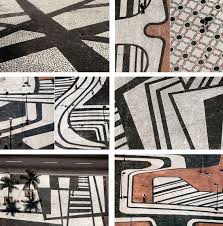
Though Marx utilized a wide variety of media -- painting and sculpture, textiles, jewelry, costume and set design, ceramics and stained glass -- it was for his spectacular undulating seaside pavements on Rio de Janeiro’s Copacabana Beach that he has always been best known, and remains influential to a whole new generation of international artists.

    According to a curator's note, "He was also an avid art collector, a talented baritone, a consummate cook, and a visionary self-taught botanist and ecologist. For him, all these endeavors were equally important, facets of one another."


 Avenida Atlântica, Copacabana, Rio de Janeiro, pavement designed by Roberto Burle Marx, 1970. © Burle Marx Landscape Studio


Mineral roof garden, Banco Safra headquarters, São Paulo, 1983. 
Photograph © Leonardo Finotti


 The son of a cultured German Jewish father and a Brazilian Catholic mother who vigorously supported his artistic tendencies, Marx viewed the role of the landscape architect in idealized and spiritual terms: to assuage mankind's exile from the 
Garden of Eden and recreate the essential bond between humanity and nature.
 
Above: Plan for the Minister’s Rooftop Garden, Ministry of Education and Health, 
Rio de Janeiro, 1938. Gouache on paper. 

Marx embraced modernism in the early 1930s, as the movement was sweeping Brazil. 
He revolutionized garden design by using abstraction and grand amoeba-like swaths of colorful vegetation, eschewing symmetry and using locally sourced plantings 
as much as possible. In his sixty-year career he designed over 2000 gardens 
worldwide and discovered nearly 50 plant species.


Edmundo Cavanellas Residence, designed by Oscar Niemeyer 
with landscape design by Roberto Burle Marx (1954)

"A garden is a complex of aesthetic and plastic intentions; and the plant is, 
to a landscape artist, not only a plant - rare, unusual, ordinary 
or doomed to disappearance - but it is also a color, a shape, 
a volume or an arabesque in itself."


Detail of Rooftop Garden of the Ministry of Education and Health 
Photograph © Cesar Barreto

"Indiscriminate planting makes a salad"
                                                   RBM 

Garden of the Fazenda Vargem Grande, Gomes residence, Areias, 1979. 
© Burle Marx Landscape Studio, Rio de Janeiro. 

As a young landscape designer, Marx was captivated by such attention-grabbers as the giant water lily Victoria Amazonica, with its circular, flat leaf, sturdy enough to bear the weight of a child. As Burle Marx later wrote, "It was in the German capital that I discovered for the first time, a large quantity of Brazilian plants being used for landscape design purposes. We Brazilians were not using these plants because we 
considered them vulgar.”

~ oOo ~ 

Closeup of tiles placed along Copacabana Beach


After its presentation at the Jewish Museum, New York, the exhibition will travel to the Deutsche Bank KunstHalle in Berlin, Germany (July 7 - Oct. 8, 2017), and the 
Museu de Arte do Rio in Rio de Janeiro, Brazil (November 2017 - March 2018).


Friday, August 26, 2016

JEWEL BOXES: Klimt's gaggle of glamourous gals coming soon to Neue Galerie, NY


         “Truth is like fire; to tell the truth means to glow and burn.”                                                                                       ... Gustav Klimt

Anyone who reads this blog knows that the Neue Galerie NY is one of my most-loved museums in the world, and that Gustav Klimt is one of my favorite early 20th century
artists. I have spent many an hour staring at the luminous and much-storied 
Adele Bloch-Bauer I, the saga of whose recovery from Nazi looting was recounted in the  2015 film "Woman in Gold". The iconic painting has now found a permanent 
home at the Neue Galerie NY, thanks to the persistence of Bloch-Bauer's niece 
Maria Altmann, and the generosity of Ronald S. Lauder, the heirs of the Estates of 
Ferdinand and Adele Bloch-Bauer, and the Estée Lauder Fund.
 
 Portrait of Adele Bloch-Bauer I, 1907
Gold, silver, and oil on canvas 

I am very pleased to let my readers know that a new exhibition of Klimt's work,
Women of Vienna's Golden Age, 1900-1918 will open at Neue Galerie NY 
on September 22, 2016. The show will put into a broader context Klimt's
fascination with the sensuality of women, and the way in which they embodied the 
spirit of fin de siècle Vienna, at that time the center of the art world.

°      °     °      °      °      °      °

The two ethereal paintings below represent some of Klimt's earliest portrait art, in which the influences of Symbolism and the Pre-Raphaelite movement are evident. Klimt (1862-1918) is considered a pivotal figure in the cultural life of late nineteenth- and early twentieth-century Vienna, and provided a vital link between nineteenth-century Symbolism and the beginning of Modernism.


Portrait of Szerena Lederer, 1899
Lederer was a Vienna socialite who built up the most important Klimt collection of her era.

 Portrait of Gertha Loew, 1902
This lovely painting of 19-year-old Gerta, swathed in white gossamer,
was also looted by the Nazis, but also was eventually recovered
and returned to the subject's daughter. 

°      °     °      °      °      °      °
Moving into the the early decades of the 20th century,
Klimt's portraits become much more lively, colorful,
and almost Fauve-like. 

 Portrait of Mäda Primavesi, 1912

Mäda Primavesi was, by her own account, "an independent, assertive young girl", 
qualities  captured in this portrait of her at about nine years old.  The image 
attests to the sophisticated taste of her parents, banker and industrialist 
Otto Primavesi and his wife Eugenia, 
ardent supporters of progressive Viennese art and design.

 Portrait of Elisabeth Lederer, 1914-1916

Elisabeth was the daughter of August and Serena Lederer, Klimt's most important patrons. 
The family's collection eventually grew to include fifteen canvases by the artist. 
Serena, whose portrait Klimt later painted, was described by many 
as "the best-dressed woman in Vienna."


Portrait of Ria Munk III, 1917

This painting is the third and final  in a series of three portraits commissioned by the Munk family of their daughter Ria. It is one of the last and most modern of Klimt’s full-length female portraits, and offers a glimpse into the artist's evovling style. The lavishly 
decorated background draws on his passion for Eastern art and 
iconography of which he was an avid collector.  
°      °     °      °      °      °      °
Portrait of Adele Bloch-Bauer II, 1907

According to curatorial notes,
"The exhibition will include approximately
12 paintings, 40 drawings, 40 works of
decorative art, and vintage photographs
of Klimt, drawn from public and private
collections worldwide. Central to the
exhibition will be the display of Portrait of
Adele Bloch-Bauer I and Portrait of Adele
Bloch-Bauer II, which will be shown side-
by-side for the first time since 2006."

Much more to come -- hats, aesthetic fashion, Klimt's muse Emilie Flöge ♥ --  
after I've seen the show! 


"Whoever wants to know something about me – as an artist which alone is significant – 
they should look attentively at my pictures and there seek to recognize 
what I am and what I want." 
                                                             ... Gustav Klimt 


~ oOo ~

 .

Friday, August 19, 2016

DESTINATIONS: Unassuming Rockland, Maine becoming the star of the state's arts scene

With its recent move into a new, purpose-built building in downtown Rockland, the Center for Maine Contemporary Art has elevated this unassuming city -- which already houses the venerable Wyeth-filled Farnsworth Museum -- into a star on the national art and design stage. The new venue, designed by architect Toshiko Mori, is expected to draw 40,000 + visitors annually. Formerly a quiet fishing village, Rockland has become a magnet for artists, hipsters and young entrepreneurs; Main St. is now replete with small shops, cafés, book stores, art supply stores and restaurants.

The new CMCA, showcasing
“Particle Soul” figures by Ogunquit artist Jonathan Borofsky
photo credit to Boston Globe

"The glass enclosed space, with its corrugated metal exterior and emphasis on 
Maine’s legendary light, is unlike anything else in the state. It’s designed to 
be accessible and inviting, with a central courtyard that offers views inside and links the space to the community like an open embrace. Here, CMCA continues its mission 
as a current and future catalyst for carrying forward Maine’s 
exceptional legacy in American art, on a whole new scale."
                                                                                                   ... Portland Press Herald

 One of the many airy galleries at the new 7,700 square foot venue
Architect's rendering by Toshiko Mori

°   °   °   °   °   °   °    °   °   °

Currently showing/upcoming exhibitions at CMCA: 

• Jonathan Borovsky: Particle Soul
   Closes August 21

 
• Laura Henkin: Second Nature
opens August 28

Henkin encourages her viewers to think about how the vast amount of imagery 
we see every day affects our relationship to the natural environment. Her art asks:
 "What is real in an increasingly digitized, virtual world?"

 
• 2016 Biennial, opens Nov. 4


An open, statewide juried exhibition featuring work in all media
produced by selected artists in the past two years.

°   °   °   °   °   °   °    °   °   °

If you're in Rockland, don't miss the highly acclaimed Farnsworth Museum.
I love the Robert Indiana "Eat" sign (originally designed for the 1964 New York 
World's Fair) that perches atop the building, rescued from demolition. 
The museum's Wyeth Center houses many memorable paintings 
by three generations of Wyeths: N.C., Andrew, and James.


 Photo by Michael Schonbach

For more information about the CMCA, link here.
 To learn more about the Farnsworth Museum, link here.

Last but not least ...
while you're in Rockland, make sure to stop in at the Project Puffin's
Main St. headquarters! You're guaranteed to leave with a smile on your face,
and possibly an armful of puffinabilia.


~ oOo ~