Saturday, February 28, 2015

REMEMBRANCE: Leonard Nimoy, visionary

In remembrance of stellar actor, photographer, poet, philanthropist and visionary Leonard Nimoy, I'm posting a 2007 article I wrote for the Jewish Ledger newspaper, about a photography workshop he taught at R. Michelson Galleries in Northampton, MA. I love this photo, with the Vulcan salute in one hand, and a water bottle in the other! It was a splendid event.


Beyond Spock: Photographer Leonard Nimoy's visionary art
© Judy Polan November 2007
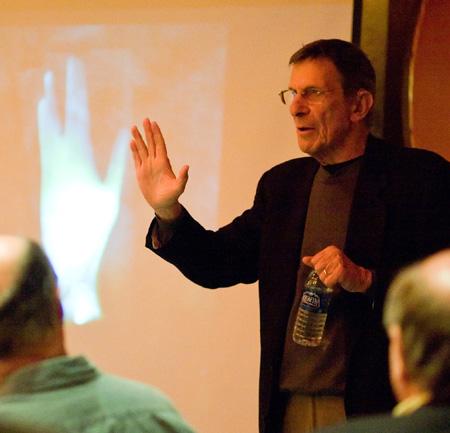

 
photo credit: Seth Kaye
 A keen group of admirers and fellow artists enjoyed the rare opportunity to hear Leonard Nimoy discuss his life as a photographer, and his spiritual journey as a Jew, when the celebrated actor/director visited Western Massachusetts last week to begin a four-day series of events hosted by R. Michelson Galleries in Northampton. Following his Friday afternoon gallery talk, he was fêted at a public reception and book signing on Saturday night, honoring his 2007 release The Full Body Project. He stayed on in town for two more days, shooting portrait photos for his upcoming book about "secret selves".
A distinguished actor in films, theater, and television -- and holder of a star on the Hollywood Walk of Fame -- Nimoy is perhaps best known for his role as the unflappable Mr. Spock in Star Trek. He is the Boston-born son of Yiddish-speaking Jewish immigrants from Russia. He grew up in a kosher, Orthodox home; he now belongs to a Reform synagogue where his wife Susan’s cousin is the rabbi. ("It’s a schlep to get there," he joked, "but we just love him.")
These days he considers himself to be "mostly retired" from acting; his life for the past decade or so has centered around photography. His 2002 Shekhina Project – a compelling and controversial photographic exploration of the womanly aspect of the divine presence – gave voice to the manner in which his Jewish identification and his photographic artistry are inextricably linked.
Pure poetry
In his November 2 gallery talk, Nimoy exuded a fascination with all things visual, and a haimish presence that immediately put his somewhat starstruck audience at ease. His presentation was accompanied by a slide show that traced his artistic development from the time he was around 13, when he became enamored of the family camera (a bellows Kodak Autographic) and learned how to develop prints "in a 15¢ solution kit and three soup bowls". During his teenage years in the 1940s, he "always had a camera loaded and ready to go." He studied at UCLA in the early 1970's under the tutelage of famed photographer Robert Heineken ("the most influential person in my photographic life") and later received an appointment as an artist in residence at the American Academy in Rome.
Throughout his worldwide travels, he has continually been on the lookout for an interesting form or texture. "I have always loved photography," he commented, "and now I have the privilege of spending most of my time thinking about and shooting pictures." He acknowledged a preference for working in black and white: "I love the pure poetry of this medium. In fine art photography, color can be a diversion."
Nimoy displayed a number of photographs of hands placed in the position used in the blessing of the Kohanim, representing the shape of the Hebrew letter shin. (This letter is often used as a symbol for one of the names of G-d; it is an abbreviation for the name Shaddai.) During the priestly blessing, the Shekhina – a Talmudic term for the visible and audible manifestations of the deity's presence on earth – is said to enter the sanctuary, casting a blinding light from which all eyes should be averted.
He first saw this gesture when he was eight years old, attending an Orthodox service with his father. "It struck a chord in me," he said. "The men were chanting –- shouting, really -- and praying. The whole thing was very passionate, very theatrical. I found it chilling, and the aura of that intensity has stayed with me." Nimoy confirmed that it was he who introduced to the Star Trek cast the shin-shaped gesture that became known as the "Vulcan salute".
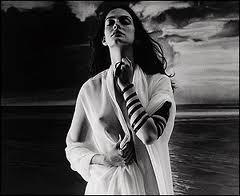
Nimoy discussed the intention behind his Shekhina Project, and the public reaction to it. This photographic series depicts a number of alluring women, some wearing prayer shawls, others wrapped in tefillin and posing "in all their naked glory. The work was viewed as transgressive by some," Nimoy commented. "There were people who were offended by the mingling of sexuality and spirituality. Others, though, saw the work as sensual and revolutionary."
A departure
Always eager to take on the next challenge, Nimoy followed up his Shekhina photo series with the one that was to become his newly released book, The Full Body Project. This photo series comprises nude images of full-bodied women, all members of a burlesque troupe called the Fat Bottom Revue. The photos are a departure for Nimoy, as his previous work focused on svelte women who epitomized the societal norm of beauty. In The Full Body Project, the women are "fleshy and proud -- irrepressible, unabashed, joyous."
Nimoy describes his work on this project as "consciousness-raising." He had never before thought about "what a huge issue body image is in our society. A gigantic, multi-billion dollar industry has sprung up to capitalize on this: diet pills, surgery, workout programs … This obsession is endemic in our culture. People are always telling you that you don't look right."
At first, Nimoy felt uncomfortable shooting the Full Body photos; he had "never worked with this kind of figure before, and I didn't want to do the women some kind of injustice." As the shoot went on, though, he grew more comfortable, helped by the presence of his wife and the high spirits of the women. He found sculptural and spiritual magnificence in them, an attitude that is strongly conveyed through the work. "I think they're beautiful –- don't you?" he asked the audience, smiling.


 ז"ל 


Thursday, February 26, 2015

UPDATES: Grand reopening of Frank Lloyd Wright's Hollyhock House, by guest blogger Joemy Wilson


Frank Lloyd Wright's stunning Hollyhock House, built in Los Angeles is 1921, recently reopened to the public for guided tours following a 4-year, $4.3 million renovation.
Originally intended as the residential section of an experimental theater campus, the home
has been named a Unesco World Heritage site -- an honor awarded to
a select group of iconic architectural masterpieces around the world.


Mad for Mod's West Coast correspondent Joemy Wilson was on the scene
for the festive grand reopening. She filed this report.
•     •     •     •     •     •     •     •     •
All the Wright Angles in Los Angeles
text and photography by Joemy Wilson
On February 13, 2015, the City of Los Angeles and the Barnsdall Park Foundation held a 24-hour open house. And not just for any old house, but Frank Lloyd Wright’s extraordinary Hollyhock House, which has been closed to the public for renovations since 2008. And not just any 24-hour period, but from 4:00 pm on Friday until 4:00 pm on Saturday afternoon. New York may be the City that Never Sleeps, but for this one night at least, Los Angeles could claim the same. Driving through rush-hour traffic, I managed to get there, and finally park, at about 4:00. Plenty of other people had the same idea.
 The press was out in force for the grand reopening. 
(Griffith Park Observatory is in the background.)

Southern Californians and Wright aficionados everywhere have been anticipating the reopening with great excitement. In 1919, oil heiress and arts patron Aline Barnsdall hired Wright to build the house, part of an extensive arts complex on Olive Hill, a stunning 36-acre site with 360-degree views of Los Angeles and the Hollywood Hills. However, the notoriously difficult architect was seldom around during construction, directing his attention primarily to the Imperial Hotel he was building in Tokyo at the same time. Costs got out of hand. Barnsdall fired Wright and hired the project manager, Rudolph Schindler, to finish the job.  Barnsdall never lived in the house, and in 1927, she gifted the property to the city.

Upon my arrival, I joined a seemingly endless, unmoving line behind the house and estimated that my own entry would occur at about 2:00 am. Or maybe dawn. Or never.  I’m not good at standing in line, especially when I don’t know what’s going on, so I asked the friendly folks behind me to save my place and confidently strolled into the park area in front of the house to find out why we weren’t moving.

Because they weren’t opening right at 4:00, of course. Four o’clock was when the opening ceremonies began. Los Angeles Mayor Eric Garcetti; Jeffrey Herr, Curator of the Hollyhock House; Linda Dishman, Executive Director of the LA Conservancy; and other dignitaries were holding forth from a platform in front of the house. I edged up the fence surrounding the audience and had a fine view of the proceedings.

Mayor Eric Garcetti and Aline Barnsdall’s granddaughter cut the ribbon


Around 5:00 PM, just when the light was so gorgeous it was almost unbearable, Hizzoner and Aline Barnsdall’s granddaughter cut the red ribbon, and the Hollyhock House was officially opened. Spirits were high. “Who’s going to be here at three am?” a speaker asked. 

Half the VIPs raised their hands. Another said, “When Aline told her friends that Frank Lloyd Wright was designing her house, they told her that she’d have to sleep out in her camper every time it rained. Well, I can tell you that this roof will never, ever leak again!” (After a $4-million renovation, let’s hope not.) Everyone praised each other and his or her staff for doing an amazing job. The announcement that the Hollyhock House had just been nominated as a UNESCO World Heritage Site elicited a roar of approval from the crowd. Everyone was grinning from ear to ear as the sun gradually set and the house gave off a golden glow. 

We were motioned up to the porch to don booties and allowed to enter in groups of 20. I was fortunate to be in the fourth group, because initially it was still possible to move around. When I had to turn in my booties at the exit, there was barely enough room to bend over to pull them off. But it was all worth it.


 Living room


 A niche in the library. Wright was working on the Imperial Hotel in Tokyo contemporaneously with the the Hollyhock House, and many details in the home 
reflect Japanese influence. An alcove such as this, serving as the focal point of a reception room with a simple but exquisitely balanced arrangement of objects, 
is a common feature of traditional Japanese homes. 
The space  is called tokonoma, or simply toko.


 View near dining room entrywayshowing restored 1920s hardware on doors


View of the courtyard from inside the entry foyer

Link here to NY Times interview with the Hollyhock House curator


Tuesday, February 10, 2015

ODD BITS: Great mod moments from Downton Abbey: To bob or not to bob?


One of the shockers on this week's Downton Abbey was Lady Mary's attention-grabbing decision to ... astonished pause ... go thoroughly mod and bob her hair! This blunt-cut hairstyle, favored by flappers, vamps, gun molls, actresses and other women of ill-repute was first introduced in 1915, when ballroom dancer and famed performer Irene Castle decided to cut her hair "for convenience". It was quickly adopted by free-spirited women of the era, whose rebellious change of hairstyle was just the beginning of a major shift in social norms -- especially as they pertained to women -- seen during the Jazz Age. As hair got shorter, so did hemlines.

F. Scott Fitzgerald's short story "Bernice Bobs her Hair" appeared in the Saturday Evening Post in 1920. In it, sweet but frumpy Bernice is convinced by her glamor-puss high society cousin that her life will improve substantially if she simply submits to the shears. The story created a sensation, and soon tens of thousands of women were bobbing their hair.


Actress/"America's Sweetheart" Mary Pickford before and after she bobbed her hair in 1928.
This act proved to be transformational for her, as she previously had been known as
"the girl with the curls". "I'm not going to be a little girl any more," she said.


The kerfuffle over bobbed hair lingered into the mid-1920s. Preachers sermonized that 
"a bobbed woman is a disgraced woman". Doctors warned that the "shingle bob" style 
could cause severe headaches. Men divorced their bobbed wives. 
Schools and department stores threatened to fire employees
 who sported the nefarious hairstyle.


By 1927, the straight, severely geometric bob had evolved into a softer cut
that introduced waves and spit curls to create a more womanly look.
Women had made their statement, and understood that
strength and femininity could coexist.


Link here for a brief PBS video about Lady Mary's daring new "do".

Oh ... and I mustn't forget my favorite bobbed TV character,
Phryne Fisher (Essie Davis) of the "Miss Fisher Mysteries".
She's dazzling!


Friday, January 23, 2015

EXHIBITIONS: Snowbirds take note! Winter art museum offerings in sunny South Florida


Calder, Untitled, 1945, gouache on paper

Abstraction on Paper
January 26 - April 5, 2015
Delving into the Museum’s rich collection of works on paper, and featuring significant loans from generous members of the community, the exhibition presents a variety of media by American and European artists from the 1920s thru the 1950s. Superb works by American Abstract Artists and other Modernists such as Alexander Calder and Wassily Kandinsky. While all 20 works were created on paper, the media used range from ink, gouache, pencil, and watercolor to etching and drypoint.


 Patkin, You Tell Us What to Do [detail], 2010, ink on pleated tulle curtains

Izhar Patkin: The Wandering Veil

January 26 - April 5, 2015
This survey of works by Israeli-born, New York-based artist, Izhar Patkin will fill the museum's main gallery space with spectacular mural-size paintings on tulle fabric. The mesmerizing display chronicles the history of modern-day Tel Aviv and Israel at large. Grand yet touchingly intimate, The Wandering Veil resonates with personal narrative, emphasizing memory, loss, love, exile and redemption.

• at the Wolfsonian in Miami's Art Deco district:


Downtown Miami in the mid-1920s

Boom, Bust, Boom: Downtown Miami Architecture, 1920s-1930s
Ends March 08, 2015

Miami's first skyscrapers, including the Miami Daily News building (now Freedom Tower), were built during the city's "boom" years following World War I. A destructive hurricane in 1926, however, dealt a devastating blow to the city's economy, worsened significantly by the onset of the Great Depression. Recovery was slow, but with the 1939 completion of the magnificent Art Deco-style  Alfred DuPont building, things started looking up. 

At the 75th anniversary of the DuPont building, The Wolfsonian reflects upon this architectural legacy and its role in transforming a seaside town into a vibrant modern metropolis.

Also at the Wolfsonian:


Rose colored mirrored glass and wooden radio with horizontal struts design
Sparton, model 517, Walter Teague designer 

Art and Design in the Modern Age: Selections from the Wolfsonian Collection
This exhibition explores the ways in which art and design have both influenced and adapted to the modern era, a time of unprecedented experimentation and innovation. Design became a critical issue for producers and consumers at a time when machine-made objects were replacing those crafted by hand. The works on display demonstrate designers’ responses to profound social and technological changes of the modern epoch. They reveal how people living in this tumultuous period viewed the world and their place in it, as urbanization, mass production, and new transportation and communication systems revolutionized modern life.

Floor lamp, desert motif, Wendell August designer


UPDATE: Glasgow School of Art rises from the ashes


On May 23, 2014, a devastating fire came within a hair's breadth of destroying the stunning Glasgow School of Art, a masterpiece of architecture designed over 100 years ago by modernist  trendsetter Charles Rennie Mackintosh. (See Mad for Mod postings of May 23 and 24.) Design aficionados all over the world despaired to hear this news. Eight months later, however, reconstruction is well underway, and due to quick action by the heroic firefighters of Glasgow, much of the building's exterior and 70% of its contents were saved.

Author and international travel director Joemy WilsonMad for Mod's first-ever guest blogger, traveled to Scotland recently, and generously contributed this optimistic report on what she saw. Thank you, Joemy!

•          •          •          •          •          •          •          •          •          •          •          •          •          •          •
Joemy’s report from Glasgow

Last autumn, my husband, Jon, and I took a long-awaited trip to Scotland. I was especially looking forward to getting lost on the lonely single-track roads of the magnificent Highlands. But first, I wanted to visit every Charles Rennie Mackintosh building that three days in Glasgow would permit. At the top of my list: one of Mackintosh’s acknowledged masterpieces, the Glasgow School of Art, built more than one hundred years ago. In May of 2014 the building had suffered a tragic fire that destroyed its iconic library and a number of its graduating students’ final art projects. I was eager but apprehensive. What would be left to see? Will the building live again?
Eastern elevation of GSA building (Douglas St.)
All photos by Joemy Wilson, unless otherwise noted


The GSA website said that tours were still being offered, so upon arrival in Glasgow we dumped our bags at the ultra-hip CitizenM Hotel and walked the few uphill blocks that took us to the school. We got there just in time for the first tour of the day and were lucky enough to draw Georgia, a current student, as our guide. Her major is painting but she loves architecture, and especially the great CRM.

The venue has had to adapt its tour drastically since the fire, of course.  Because the interior has been closed to visitors for several months, we began at the undamaged eastern side and continued around the block. Georgia pointed out the ornamentation: the symbol of St. Mungo, with the bird, tree, fish and ball; and the Glasgow Rose elements in front of the windows. She told us Mackintosh’s story, from student to master architect.


Around the corner behind the school, Georgia showed us a building with a plaque reading 
The • Glasgow • Society • of • Lady • Artists •1882. 
(Men and women were kept apart in school in those days, except for special evening events.) She pointed out the elegant wrought-iron door, which Mackintosh designed in 1908. Interestingly enough, this door was also a replacement after a previous fire! How nice to learn that Mackintosh, who championed women artists, designed the door for these “ladies.”

We continued around the block. There was the library tower, covered in scaffolding. It was crawling with the most enthusiastic hardhat workers I’ve ever seen. They were calling to each other cheerfully, giving every indication that it was a personal joy for them to help recover this cultural treasure for Glasgow and for the world.

Sunlit view of library at Glasgow School of Art. The library was destroyed in the fire.
Photo courtesy of scotcities.com.

Georgia showed us a photo of the singular library interior, which she said will be restored down to the most minute detail. It will probably take five years, but fortunately, she told us, it was “one of the most photographed rooms in the world.” Also, providentially, there is a 360° computer rendering of the space, and everyone is confident that Mackintosh’s vision can be reproduced. Skilled craftsmen are already researching the proper materials, a phase that alone will probably take at least a year.
Greatly cheered, we went off to celebrate with lunch at the nearby Willow Tea Rooms on Sauchiehall Street. As we sat in Mackintosh’s gorgeous Room de Luxe, we clinked teacups in a toast to a genius architect whose masterpiece will certainly live again.
Room DeLuxe at the Willow Tea Room, another Mackintosh creation
CRM designed everything, from room interior to utensils to waitresses' uniforms

Detail of Willow Tea Room mirrors


While I nibbled on my sandwich, I thought of the brave firefighters whose brilliant strategy of forming a human wall up the west end of the main staircase probably saved the vast majority of the school building and its priceless artwork. I thought of the archives that were miraculously saved. I thought of those animated construction workers, cheerfully toiling away to resurrect a treasured icon. 
And I thought of the phoenix rising from its ashes, and how we can look forward to returning in a few years to see the restored library in all its glory. 

Front entrance to GSA, Renfrew St.
Photo courtesy of Tripandtravelblog.com

To contact Joemy with feedback or questions, email her at JoemyTD@aol.com

•          •          •          •          •          •          •          •          •          •          •          •          •          •          •

For information on another Mackintosh masterpiece, the House for an Art Lover,
link here to my article originally published in Style 1900 magazine.